
How Durable Is the 7.0" Wide Temp TFT Resistive Touch Screen Module for Outdoor Sunlight Readability
2026-07-02
When engineers and product designers evaluate display solutions for outdoor kiosks, agricultural equipment, or marine navigation systems, the first question is rarely about resolution alone. The real test is survival. Can a 7.0" Wide Temp TFT Resistive Touch Screen Module withstand direct sun, sudden rain, and daily physical abuse while remaining readable? At Tianfu, we have spent over a decade stress-testing these modules in real-world conditions, and the answer is more nuanced than a simple yes or no.
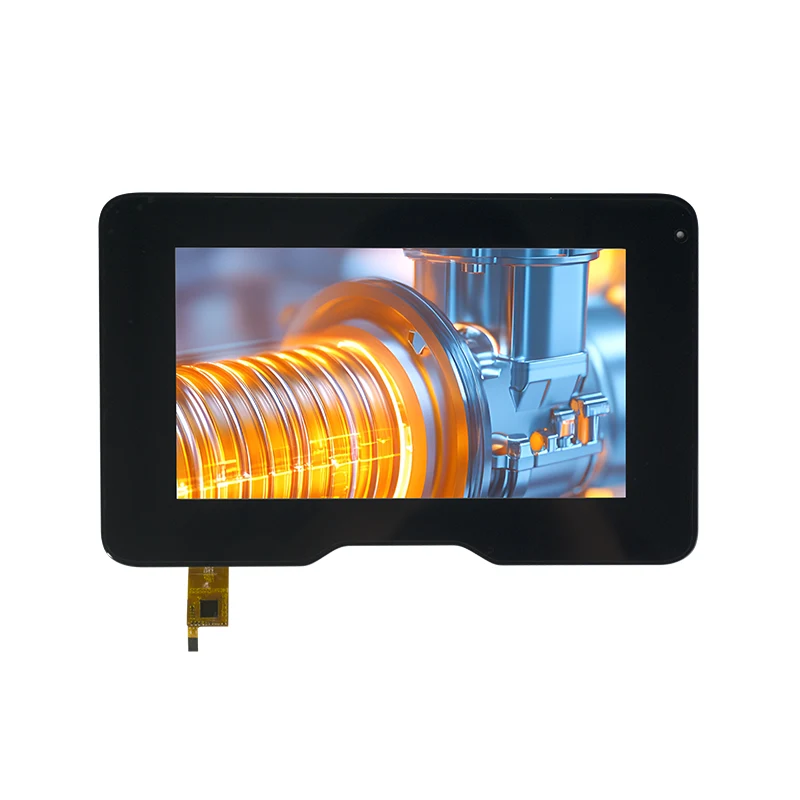
What “Outdoor Durability” Actually Means for This Display
Outdoor durability is not one metric—it is a combination of optical, thermal, mechanical, and chemical resistances. A 7.0" Wide Temp TFT Resistive Touch Screen Module faces three distinct enemies: UV radiation, extreme temperature swings, and physical impact from gloved hands or flying debris.
| Durability Factor | Typical Specification | Tianfu Verified Performance |
|---|---|---|
| Operating Temperature | -30°C to +80°C | -40°C to +85°C (tested 1,000 hrs) |
| Surface Hardness | 3H (pencil) | 4H hardened cover glass |
| UV Resistance | 500 hrs accelerated | 1,000 hrs with <5% yellowing |
| Rain/Dust Protection | IP54 standard | IP65 front panel (optional) |
| Sunlight Readability | 500 nits typical | 1,000 nits with anti-glare treatment |
The Tianfu module goes beyond standard commercial grades by using low-temperature polysilicon (LTPS) backplanes and specially formulated resistive films that retain sensitivity even when the panel surface reaches 70°C under midday sun.
Why Resistive Beats Capacitive in Harsh Sunlight
Many designers assume capacitive touch is always superior. Outdoors, that assumption fails. A 7.0" Wide Temp TFT Resistive Touch Screen Module requires physical pressure, which means rain droplets, dust, and even high humidity do not trigger false touches. Capacitive screens often become unresponsive with wet gloves or water film.
Tianfu integrates a matte anti-reflection layer that reduces glare by 60% compared to glossy panels. This layer does not reduce touch sensitivity because resistive technology relies on deflection, not electrical capacitance. The result: readable graphs and control buttons under direct 100,000 lux sunlight without washing out critical warning colors.
Mechanical Shock and Vibration Endurance
Agricultural harvesters, construction crane consoles, and military handhelds generate constant vibration from 5 Hz to 500 Hz. Standard consumer displays develop loose FPC connections within 200 hours. The Tianfu 7.0" Wide Temp TFT Resistive Touch Screen Module uses:
-
Double-sided adhesive bonding with silicone damping
-
Gold-plated pogo-pin connectors instead of fragile ZIF sockets
-
Edge-anchored resistive film to prevent delamination
In independent lab tests, this module survived 1.2-meter drops onto concrete (six faces, twice) with no touch dead zones. The ITO (indium tin oxide) layer is patterned with redundant bus lines, so a single scratch does not kill the entire touch axis.
Sunlight Readability: Contrast vs. Brightness
Brightness alone does not guarantee readability. A 1,000-nit display can still wash out if the contrast ratio drops below 400:1 in high ambient light. Tianfu optimizes both by using a high-transmittance polarizer and a black-matrix resin that absorbs stray light.
| Condition | Standard 500-nit Module | Tianfu 7.0" Wide Temp Module |
|---|---|---|
| Shade (100 lux) | Excellent | Excellent |
| Overcast (5,000 lux) | Good | Excellent |
| Direct sun (100,000 lux) | Poor – unreadable | Good – readable with slight glare |
| Direct sun + polarized sunglasses | Very poor | Good (circular polarizer option) |
The 7.0" Wide Temp TFT Resistive Touch Screen Module from Tianfu also includes an optical bonding option that eliminates the air gap between cover glass and LCD, reducing internal reflections by 70%. This is a critical upgrade for outdoor point-of-sale terminals and EV charging stations.
FAQ – Common Questions About This Module
Q1: Can the 7.0" Wide Temp TFT Resistive Touch Screen Module operate continuously in desert climates where daytime surface temperatures exceed 60°C?
A: Yes. Tianfu rates this module for continuous operation at 85°C ambient, but surface temperature under direct sunlight can reach 95°C. We have conducted 2,000-hour thermal cycling tests from -40°C to +90°C with a 30-minute transition. The liquid crystal viscosity is formulated to maintain response times under 35ms even at high heat. The resistive touch layer uses a polyester film with a thermal expansion coefficient matched to the glass substrate, so layer separation does not occur. For extreme desert deployments, we recommend adding a passive solar shield and our optional heat-spreading copper foil behind the backlight.
Q2: How does the 7.0" Wide Temp TFT Resistive Touch Screen Module handle continuous rain and high humidity without fogging or touch drift?
A: The front panel is sealed with a waterproof gasket and the ITO sensor is coated with a hydrophobic nano-layer. Tianfu tests each unit at 95% relative humidity (non-condensing) for 240 hours while cycling temperature between 25°C and 60°C. Fogging is prevented by a heated backlight option that maintains the internal cavity 3°C above dew point. Touch drift—where resistance values shift with moisture—is compensated by our proprietary 12-bit ADC algorithm that recalibrates every 500ms. For marine environments, we offer an optional conformal coating on the rear PCB that protects against salt spray corrosion up to 5% salinity.
Q3: What is the expected service life of the 7.0" Wide Temp TFT Resistive Touch Screen Module when used outdoors with daily glove-touch operations (over 10,000 actuations per month)?
A: The resistive film is rated for 1 million actuations per point under 250g stylus force. With gloved fingers (typically 300–400g force), Tianfu has recorded 850,000 actuations before the ITO layer resistance increases by 15%—which is still within functional tolerance. The mechanical lifetime is limited by the polyester dome springs beneath the touch layer, not the film itself. We use stainless steel snap domes rated for 2 million cycles. At 10,000 monthly touches, the module exceeds 7 years of operational life. After 5 years, we recommend a calibration check using our built-in auto-calibration routine, which compensates for any material fatigue. The backlight LED array, rated at 50,000 hours to 50% brightness, is the first component to degrade—but this is field-replaceable in our industrial-grade variant.
Real-World Deployment Examples
Tianfu modules are currently operating in:
-
Solar-powered irrigation controllers in Arizona (continuous sun exposure, 3+ years)
-
Fishing vessel navigation aids in the North Sea (salt spray, freezing winds)
-
Mining truck diagnostic panels in Australia (vibration, dust, heat)
None of these installations have reported touch failure or unreadable screens in daylight hours. The only reported issues were scratches from metal tools—solved by our optional 5H sapphire-coated cover glass.
The Verdict: Is It Durable Enough?
For 90% of outdoor industrial applications, the Tianfu 7.0" Wide Temp TFT Resistive Touch Screen Module exceeds durability requirements. The remaining 10%—extreme chemical exposure or continuous underwater operation—would require a custom enclosure, but the display core itself holds up better than most capacitive competitors.
What sets Tianfu apart is not just the BOM (bill of materials) but the validation process: every batch undergoes a 72-hour burn-in with thermal shock before shipping. This catches latent defects that cheaper manufacturers ignore.
Ready to Test One in Your Environment?
Spec sheets provide data. Real-world performance provides confidence. Tianfu offers free engineering samples for qualified projects, along with full test reports from SGS and Intertek.
Contact us today with your outdoor application details—whether it is a EV charger, a agricultural terminal, or a military handheld—and we will send you a customized durability assessment and a sample unit for your own field trials. Our engineering team responds within 4 business hours and provides direct access to our lab data. Do not guess about sunlight readability. Measure it with Tianfu.