
Wholesale Arc Fault Detection Device: Key Factors for Bulk Purchasing
2026-09-29
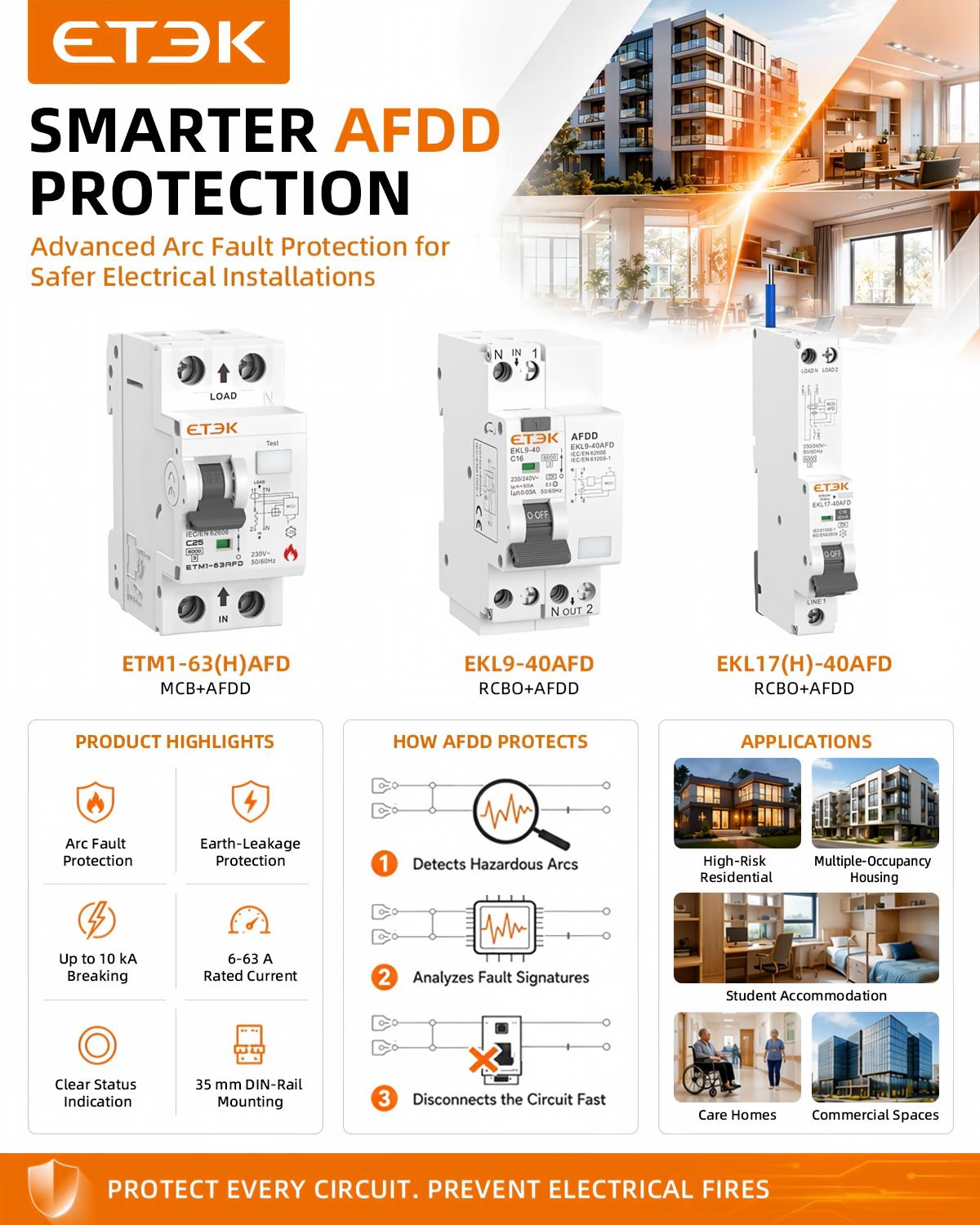
Electrical safety isn’t just a compliance checkbox—it’s the foundation of every reliable installation. But when you’re sourcing arc fault detection devices in bulk, the stakes multiply. Generic suppliers may promise low prices, yet hidden compromises in detection accuracy, response time, and certification can surface after installation. That’s where a focused procurement strategy becomes essential. In this post, we break down the key factors for wholesale Arc Fault Detection Device purchasing, including batch consistency, technical support, and why partnering with a manufacturer like ETEK can protect your margins and your reputation.
Sensitivity Settings You Can't Afford to Overlook in Bulk Arc Fault Orders
When buyers place large orders for arc fault protective devices, the talk usually revolves around price breaks and lead times. Sensitivity rarely gets a mention until a batch of breakers starts tripping on harmless motor sparks or, worse, stays silent during a real arc. The adjustable threshold—often expressed in milliseconds or arc energy levels—determines whether a unit reacts to a frayed extension cord or ignores the brush noise from a vacuum cleaner. In bulk purchases, a single default profile can be wrong for half the installation sites, leaving electricians to chase phantom trips or bypass protection altogether.
Mismatched sensitivity often shows up in mixed-load environments. Warehouses with old fluorescent ballasts, workshops running variable frequency drives, and residential panels serving older appliances all produce different electrical signatures. A unit tuned too aggressively will treat normal commutation as a fault; one set too loose may not catch a low-current series arc until the damage is done. For bulk orders, that means the smart move is to split the purchase across two or three sensitivity tiers rather than standardizing on a single part number. Yes, it complicates inventory slightly, but it cuts the number of callbacks and code-compliance headaches down the road.
Another overlooked factor is whether the sensitivity can be field-adjusted after installation. Some manufacturers lock the threshold at the factory, while others leave a small dial or digital menu for calibration. In bulk, the locked version looks cheaper because it keeps the SKU simple, but it forces every circuit to accept the same personality. A better approach is to sample a few locations before committing to a full container. Run the devices under real loads for a week, note the nuisance trip rate and any missed-arc events, then adjust your bulk specification accordingly. That extra step costs far less than reworking a hundred panels or explaining to a client why their brand-new breakers either chirp all night or never make a sound.
Why Some Certification Marks Look Official but Won't Pass Inspection
At first glance, many certification marks carry the weight of authority—crisp logos, bold seals, and language that sounds reassuringly official. But a closer look often reveals that these symbols are little more than decorative stamps. Some organizations design their own emblems from scratch, borrowing visual cues from real regulatory bodies without ever undergoing a single audit or meeting a published standard. The mark might include words like “verified” or “approved,” yet no independent third party ever examined the product, process, or facility behind it.
The gap between appearance and substance becomes obvious during an actual inspection. Inspectors trained to recognize legitimate certifications look for traceable documentation, a clear set of criteria, and evidence of ongoing oversight. A self-issued mark rarely has any of these. Instead, you find broken chains of accountability: no named standards body, no public registry, no defined frequency of checks. The visual polish that made the mark seem credible online or on packaging quickly falls apart under scrutiny.
In many cases, the difference comes down to consequences. Authentic certification programs are built around measurable outcomes—failed audits lead to suspension, and complaints trigger re-evaluation. Look-alike marks exist only as a marketing asset. They promise assurance without any mechanism to deliver it, and when an inspector arrives, the lack of records, trained assessors, and corrective action procedures is impossible to hide.
Unit Price vs Total Cost for Bulk Arc Fault Device Orders
When sourcing arc fault devices in volume, the gap between a tempting unit price and the actual total cost can quietly eat away at your budget. A per-piece quote might look lean on paper, but freight, customs handling, and warehousing fees often add layers that only surface once the shipment is en route. Smart buyers treat the unit price as a starting point, then map every downstream expense before comparing offers.
Bulk orders also shift how you should weigh order size against price breaks. Jumping from 500 to 2,000 units can drop the unit cost by 12-18%, but if that larger order forces you into long-term storage or risk of code changes making stock obsolete, the total outlay climbs. The real savings appear when you match your order quantity to your installation pipeline rather than chasing the steepest discount curve.
One practical approach is to request a landed-cost breakdown from each supplier: ex-works price, inland transport, sea or air freight, insurance, and any import duties. Then add your internal receiving and quality-inspection hours. When you lay these side by side, a supplier whose unit price is 5% higher can often deliver a 9% lower total cost because of better packaging density or a nearby consolidation warehouse. Choosing by unit price alone leaves that kind of money on the table.
Can Your Supplier Scale to Your Peak Season Demand?
Peak season doesn't wait for anyone. When orders spike, the real question isn't whether your supplier has enough capacity today—it's whether they can flex quickly without breaking your delivery promises. Many buyers make the mistake of only checking current output. Instead, dig into how your supplier handled their last three peak cycles. Did they add temporary lines? Cross-train staff? Pre-book raw materials? A supplier that merely promises they'll manage usually can't.
Ask for specific numbers: what percentage over baseline can they sustain for four, six, eight weeks? How fast can they onboard additional shifts or subcontract without quality slipping? Look for evidence, not assurances. Visit during a live rush if possible, or ask to speak with a reference who ordered 40% above their normal volume. The suppliers that genuinely scale have a documented process—backup machinery, supplier-side raw material buffer, and clear overtime policies. The ones that don't will start missing ship dates by week three.
Also check their communication rhythm under stress. A partner who responds in hours rather than days during crunch time is worth far more than one with a shiny factory but slow decision-making. Peak season exposes every weak link in the chain. If your supplier treats your forecast as a guess rather than a commitment, you're already behind. Build a shared ramp-up plan well before the rush, so when demand hits, you're both executing—not negotiating.
Custom Trip Curves and Communication Protocols That Add Hidden Value
Adjustable trip curves let you match breaker behavior to the actual load profile instead of relying on broad defaults. For a motor with high inrush current, a custom curve delays tripping long enough to ride through startup while still clearing genuine faults quickly. That single change can eliminate false trips that interrupt production and erode confidence in the protection system.
On the communication side, protocols like Modbus RTU or IEC 61850 turn a breaker from a standalone device into a source of operational data. You get load current, trip history, and wear indicators without opening panel doors. Maintenance teams can spot developing issues—say, a gradual rise in operating temperature—and schedule intervention before an unplanned outage occurs.
The Fine Print on Returns When a Pallet Arrives Damaged
Most buyers assume a damaged pallet means an automatic refund or replacement, but the actual return terms often hinge on a handful of small clauses buried in the freight agreement. Carriers typically want damage noted on the delivery receipt at the moment of signing—scribbling “subject to inspection” rarely counts as a formal damage claim. If you accept the pallet without a clear exception on the Bill of Lading, the seller can argue the goods arrived in acceptable condition, and the return window may shrink to just a few business days.
Even when the damage is obvious, the return path is rarely free. Some vendors require you to hold the original pallet, including all broken boards and torn wrap, for a carrier inspection that could take a week or more. Restocking fees on freight returns can reach 20–25%, and if the pallet was custom-strapped or heat-treated for export, you may be on the hook for repackaging costs that were never mentioned at checkout. Photos help, but they need to show the pallet ID, the consignee label, and the damage in a single frame—otherwise the claim can stall while you wait for a decision.
FAQ
An AFDD continuously monitors circuit waveforms for dangerous arc signatures that standard breakers miss. Buying in bulk makes sense for contractors and panel builders who need consistent protection across multiple installations without juggling different brands or specs.
Look for UL 1699 in North America or IEC 62606 in most other markets. Also ask for third-party test reports covering voltage ratings, trip times, and false-trip resistance. Local electrical code approvals often override generic certificates, so verify those first.
Request a pilot batch of 20-30 units and test them on real circuits with known arc faults. Check the supplier's defect rate over the last 12 months, ask for references from other bulk buyers, and confirm their warranty replacement process doesn't require shipping units back for every minor issue.
Focusing only on unit price and ignoring compatibility with existing panel busbars, skipping a field trial, and not confirming whether firmware updates are included. Another big one is ordering without a clear lead time buffer for rework if a batch fails incoming inspection.
Integrated units reduce wiring clutter and installation time, but separate devices make fault isolation easier during maintenance. For high-end residential projects integrated is usually fine; for commercial or industrial panels where downtime is costly, separate units give your technicians more control.
Don't anchor on per-unit cost alone. Ask for tiered discounts tied to annual volume, longer payment terms instead of small upfront discounts, and a consignment stock option for recurring projects. Suppliers often have more flexibility on warranty extensions or free firmware upgrades than on the base price.
A quality AFDD should handle at least 10,000 trip cycles and include a self-test function. Demand a minimum 3-year warranty with a no-questions replacement policy for the first 12 months. If the supplier offers less than 2 years, treat that as a red flag for hidden quality issues.
Most mid-size and larger manufacturers offer OEM or private label options, but minimum order quantities usually start around 500-1000 units. You'll need to provide artwork files and approve a pre-production sample. Lead times for custom labeling typically add 3-6 weeks to the standard production schedule.
Conclusion
When sourcing arc fault detection devices in volume, the decisions that matter most rarely show up on a quote sheet. Sensitivity settings are a prime example: a unit calibrated too aggressively trips on harmless fluctuations, while one set too loose misses the very arcs it exists to catch. Matching trip thresholds to the actual electrical environment—motor loads, lighting ballasts, variable frequency drives—prevents callbacks that erode margin. Equally deceptive are certification marks that mimic legitimate testing logos yet trace back to no recognized laboratory. Inspectors in many jurisdictions cross-check the mark against an online database, and a pallet of devices with hollow credentials becomes a financial liability. Then there is the gap between unit price and total cost: freight, import duties, compatibility with existing panels, and long-term failure rates often outweigh a per-unit discount. A supplier's ability to scale during your peak season matters just as much, because a missed delivery window halts entire projects.
Bulk orders also hide value in customization that doesn't inflate base price. Custom trip curves matched to unusual loads and communication protocols—Modbus, BACnet, or proprietary interfaces—let the devices integrate into building management systems without costly retrofits, a benefit felt long after installation. Finally, read the returns clause before signing. When a pallet arrives damaged, the distinction between carrier liability and supplier replacement policy determines whether you wait weeks or resume work in days. Some suppliers quietly charge restocking fees even for shipping damage, while others exclude concealed damage after 48 hours. Negotiating these terms upfront protects cash flow and project timelines. In short, bulk purchasing arc fault detection devices rewards buyers who treat the order as an operational commitment rather than a transactional price comparison.
Contact Us
Contact Person: Andy
Email: [email protected]
Tel/WhatsApp: +86 13356133008
Website: https://www.etek-china.com/