
Top Survival Kit Factory Essentials for Reliable Emergency Kits
2026-10-25
When disaster strikes, the difference between chaos and control often comes down to one thing: the quality of the survival kit you have on hand. But not all emergency kits are built equal—many are assembled without real-world testing or dependable sourcing. In this guide, we break down the factory essentials that separate a life-saving kit from a false sense of security, and show why Kebon has become a trusted name among buyers who refuse to compromise.
Survival Kit Factories Worth Their Salt Start with Raw Material Audits
Most survival kit manufacturers skip the unglamorous step of auditing raw materials, and their products pay for it later in the field. A reputable factory treats every incoming batch of steel, nylon, adhesive, and water purification chemicals as a potential point of failure. They don't just check a supplier's certificate; they run their own tensile tests on cordage, measure blade hardness after heat treatment, and simulate moisture exposure on fire-starting components. This obsession with inbound inspection separates kits that work when you're stranded from kits that look good in an online photo.
The difference becomes obvious when you look at how raw material audits handle variability. A factory worth trusting maps each lot of raw stock to specific production runs, so if a batch of flint rods underperforms in spark tests, they can trace which kits used those rods and hold them back. Low-budget operations blend everything into one pile, then wonder why a small percentage of customers report dead lighters or brittle plastic buckles. Auditing forces accountability before assembly, not after warranty claims pile up.
What surprises outsiders is how much of this audit work happens at the loading dock, not in a lab. Forklift drivers log pallet temperatures for heat-sensitive desiccants; warehouse staff reject corroded wire before it reaches the cutting station. These aren't glamorous jobs, but they quietly ensure that a survival kit's whistle still works after six months in a car trunk or a lifeboat locker. Factories that skip this step are betting their reputation on luck, and luck runs out exactly when someone needs a signal fire.
Why Your Emergency Kit’s Zipper Tells You More Than Its Price Tag
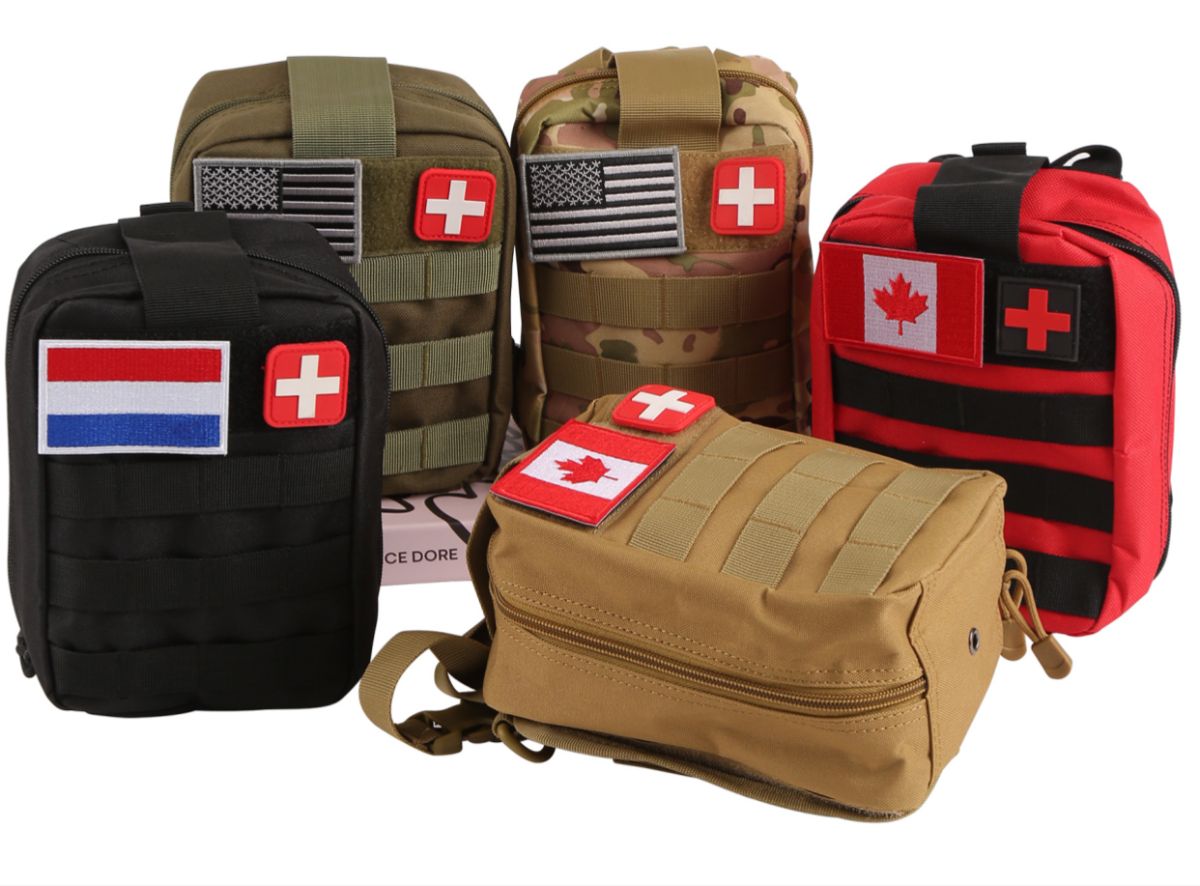
The zipper on your emergency kit is a quiet storyteller. A stiff, snagging pull reveals corners cut long before you ever needed to rely on it—cheap coil, flimsy tape, a slider that jams under pressure. When you actually need that kit, fumbling with a bad zipper wastes seconds that feel like hours. A smooth, glove-friendly pull with a solid lock and reinforced stitching, on the other hand, tells you someone thought about your hands shaking, about darkness, about one-handed use while holding a flashlight between your teeth.
Price tags lie. A premium-looking case can hide a zipper that fails after three pulls, while a modest bag might use a chunky molded-tooth zipper that outlives the gear inside. Run your thumb along the teeth—do they feel rounded and consistent or sharp and uneven? Unzip it fully and listen: a quality zipper whispers, it doesn't grind. Bend the fabric near the zipper tape; if it puckers or frays, the whole kit will betray you at the worst possible moment.
Next time you shop, ignore the shiny logo and start with the zipper. Zip it closed, open it, then zip it again with your non-dominant hand and your eyes closed—that's the real test. The zipper is the one component you'll touch more than any other in a crisis. If it doesn't feel like a trusted tool, walk away, no matter how impressive the spec sheet looks.
From Assembly Line to Trunk Without Losing Reliability
A car rolling off the line isn't handed over right away. Before it ever sees a customer's driveway, it endures a gauntlet of vibration rigs, temperature swings from -30°C to 60°C, and humidity chambers that run for weeks. These aren't token checks — they're designed to shake loose any marginal solder joint, crack a weak weld, or expose a sensor that drifts under thermal stress. The whole point is to fail the car in the factory, where fixing it costs minutes, not months of customer frustration.
Then comes the journey. Whether it's loaded onto a railcar or a covered truck, each unit gets a custom-fitted cradle with dampened straps, not just generic wheel chocks. Shock loggers record every jolt during transit, and if a preset threshold is exceeded, that vehicle is flagged for a full re-inspection at the destination. Upon arrival, a technician runs through a 23-point checklist — re-torquing suspension bolts, verifying alignment hasn't shifted, and recalibrating driver-assist cameras that can be knocked out of spec by a few harsh potholes. Only after that does the car move to the detail bay, then to the customer, with the same dimensional accuracy and electrical integrity it had when the first bolt was torqued at the plant.
The Drop, Soak, and Crush Gauntlet Every Kit Must Survive
The drop test is where most so-called rugged cases go quiet. We don't bounce them off a padded mat—they come off the back of a moving pickup at 25 mph, or get tossed down a flight of concrete stairs. You'd be surprised how many hinges shear off and how many latches pop open on the first bounce. The ones worth keeping are the ones that still close tight after the third or fourth impact, with nothing rattling inside.
Next comes the soak, and this is where cheap foam inserts and flimsy gaskets get exposed. We leave each kit fully submerged in a tub of silty water for 24 hours, then drop it in again while it's still wet. If a single drop gets past the O-ring or the zipper track, the inside smells like a swamp and the tools start rusting within a week. A few designs actually use a pressure-release valve that lets air out but not water in—that's the kind of detail you only notice when you're drying out a ruined first-aid kit.
The crush test sounds brutal because it is. We run a loaded kit under the wheel of a 4Runner, then stack two pallets of bagged concrete on it overnight. Most plastic shells crack along the corners or warp until the lid won't seat. The survivors don't need to look pretty—they just need to keep their shape, keep their seals, and keep everything inside from turning into dust.
Packing Density Matters More Than Gear Count
Many mechanical designers fixate on the number of gears in a transmission, assuming more gears automatically translate to better performance. That assumption rarely holds up under real-world constraints. What actually drives efficiency and durability is packing density—how much tooth contact surface you can fit into a given volume without compromising lubrication or heat dissipation. A compact gear set with tightly packed, well-matched teeth often outperforms a larger assembly with extra gears that add weight, friction, and alignment complexity.
High packing density allows smoother load distribution across each tooth flank, reducing peak stress and extending service life. It also shortens the torque path, which cuts energy losses from shaft deflection and bearing drag. In practice, a single well-designed gear pair with optimized profile and high contact ratio can replace two or three ordinary pairs, delivering the same ratio in half the space. That advantage shows up clearly in electric vehicle reducers and robotics, where every millimeter matters.
So before adding another gear to the train, ask whether the existing mesh is using its available face width and overlap ratio efficiently. Often, the smarter move is to increase the module slightly, widen the teeth, or choose a better helix angle to raise packing density. Gear count is just a number. Packing density is what makes the number meaningful.
Traceability in Survival Kit Production Goes Beyond a Sticker
In many factories, traceability is treated as an afterthought—a barcode slapped on the final package. But for survival kits, that sticker tells only a fraction of the story. Real traceability starts long before assembly: the origin of the waterproof matches, the batch of the emergency blanket, the date the water purification tablets were pressed. Without that granular record, a recall becomes guesswork.
Manufacturers who take this seriously link each kit to a digital file that follows every component through incoming inspection, storage conditions, and final testing. If a blade supplier changes their steel source, the file is updated. If a batch of adhesive fails a humidity test, every kit containing that adhesive can be pulled in minutes, not weeks.
This level of oversight doesn't just satisfy regulators. It gives buyers confidence that the kit in their trunk or go-bag hasn't been assembled from untracked, possibly substandard parts. The sticker on the outside is merely the visible endpoint of a discipline that runs through the entire supply chain.
FAQ
It usually comes down to whether they treat every component like someone's life depends on it. A solid factory insists on sourcing materials with verified track records, runs batch tests that simulate real field abuse, and keeps detailed records so a flaw can be traced back to the exact production line.
Water purification and fire-starting gear top the list. If those fail, the rest of the kit becomes dead weight. Factories that care will test water filters under turbid conditions and make sure ignition sources work after being soaked or crushed.
They avoid relying on a single supplier and don't let one inspector sign off on everything. Cross-checks, random pulls from finished pallets, and aging tests on adhesives and seals all help catch drift before it leaves the dock.
More than people expect. A kit that gets crushed in a car trunk or soaked in a storm is useless. Good factories use compression testing, moisture barriers, and tamper-evident seals that still open easily with cold hands.
Redundancy isn't wasted space in an emergency. Reliable factories understand that fine motor skills vanish under stress, and a backup that works in wet weather can mean the difference between warmth and exposure.
Ask for failure rate data, not just certifications. Request samples from the middle of a production run, not the beginning, and find out how they handle a recall. A factory that hesitates to discuss defects probably hides them.
Some run kits through drop tests, freeze-thaw cycles, and high-humidity storage. Others give prototypes to outdoor guides or disaster response teams and actually track what breaks in the field. The good ones change the design instead of blaming the user.
Specialization tends to produce fewer surprises. A factory that only makes vehicle emergency kits, for example, learns the weak points that a generalist won't notice until a customer complains.
Conclusion
A survival kit factory that takes reliability seriously begins long before the first component is packed. Raw material audits are the quiet foundation: every cord, blade, and fire starter must meet strict specs, because a batch of brittle plastic or weak stitching can turn a rescue tool into a liability. Yet the small details often speak loudest—like the zipper. A cheap zipper that jams after two uses reveals more about quality control than any glossy spec sheet. The best factories treat closure mechanisms as critical life-support hardware, not afterthoughts, testing them under grit, salt spray, and repeated stress. From there, the journey moves along an assembly line engineered for consistency, where torque checks on sealed pouches and heat-seal inspections happen at every station. The goal is not just to build a kit, but to ensure it arrives in a trunk or backpack with the same integrity it had when it left the factory floor.
That reliability is earned through abuse. Every finished kit faces a gauntlet of drop, soak, and crush tests—simulating a fall from a truck bed, a flash flood, or a heavy tool chest landing on top. Surviving that is table stakes. But smart factories think beyond brute durability. Packing density is a hidden art: a kit stuffed with a dozen mediocre items is less useful than one with half as many, arranged so each piece is accessible in the dark and protected from friction. Finally, traceability ties it all together. It is easy to slap a batch number on a box, but genuine traceability means every component can be traced to its raw material lot, its production shift, and its specific test record. When a defect is found in one zipper, the factory can isolate the affected kits in minutes, not weeks. That kind of accountability is what separates a novelty tin of gadgets from a true emergency lifeline.
Contact Us
Contact Person: Andy Yu
Email: [email protected]
Tel/WhatsApp: +86 19858933676
Website: https://www.kebonfirstaid.com